Lost in Translation: Brown Skin and the AI Art Generator's Vocabulary Problem
A working hypothesis about medium brown skin tones, AI image generator prompts, and the language of color
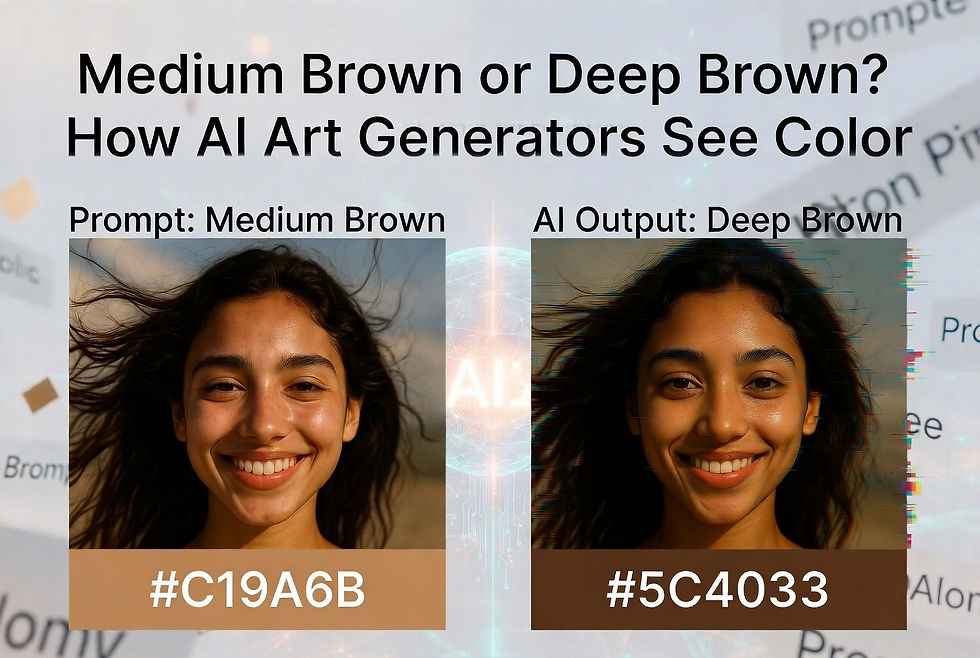
Here is the short version of what I think may be happening in AI art generation: the language model and the image generator may not be using the phrase “deep brown” in exactly the same way. In everyday beauty language, even relatively light or medium brown skin tones are often described and widely accepted as “deep brown.” But on a color spectrum, “deep brown” usually points to something darker.
So when an AI system identifies a medium brown skin tone as “deep brown,” and that label gets reused as a prompt, the image generator may render the darker color value rather than the socially broadened meaning of the term. That possible gap between language and color is what I am trying to describe here.
I am not writing this as a color theory expert. I am writing as someone experimenting with AI image generation and noticing a repeated pattern in how brown skin tones seem to be translated from words into images.
My Working Hypothesis About AI Art Generator Skin Tone Prompts
My working hypothesis is that some AI systems may be trained on language where “deep brown” has already expanded beyond strict color-value meaning. If the model learns that broader usage from captions, labels, and beauty-related text, it may apply “deep brown” to skin tones that are actually medium brown in color-value terms.
Then, once that label is handed to the image generator, the generator may interpret “deep brown” more literally as a darker point on the color spectrum. If that is right, the problem is not simply that the model is bad at rendering brown skin. The problem may be that the prompt vocabulary and the color rendering system are not aligned.
Where the Mismatch May Be Happening
From what I understand, color theory uses words like “deep,” “light,” and “medium” in a more value-based way. In that kind of framework, “deep” points toward darker values on the spectrum. But that is not always how the word is used in everyday conversation about brown skin.

In beauty culture, fashion, makeup language, and social media, “deep brown” can function more loosely. It is sometimes used for a wide range of brown skin tones, including shades that may look more medium than deep from a color-analysis perspective. Over time, that broader usage may become normal enough that it no longer feels imprecise.
That matters because AI is trained on a huge amount of image-text pairing and descriptive language. So even if the system is highly capable, it may still inherit a messy vocabulary. In other words, the intelligence of the model does not automatically remove ambiguity from the words it learned.
That is the core of the issue as I see it: the prompt may be using “deep brown” in the socially expanded sense, while the image generator may be rendering it in the color-spectrum sense.
Why the Language Gap Matters
The more I think about it, the more this seems like a language gap. A single phrase can carry one meaning in everyday usage and a different meaning in a more technical color-value context. If AI has absorbed both meanings, then prompt interpretation can get unstable.
That may be why a phrase like “deep brown” can feel accurate to a person describing a complexion, yet still produce an image that comes out too dark. The wording may make sense socially, while the rendering engine treats it as a stronger color instruction.
So the mismatch may not be between the user and the AI alone. It may also be happening inside the AI system itself, between how a term is learned and how that term is visually rendered.
Skin Tone Prompt Words That Seem to Work Better Across AI Art Generators
So far, it seems helpful to step outside the beauty-language vocabulary that may be causing the drift. These are a few skin tone prompt phrases that have seemed more useful to me when I am trying to describe warm medium brown skin in AI art generation:
· Warm tan — tends to land closer to medium without pulling toward deep value rendering
· Warm caramel / warm toffee — food adjacent language that carries its own lightness associations and sidesteps the beauty lexicon entirely
· Light-medium brown — the hyphen seems to do something; it pulls the output back from the deep end
· Direct hex input — where the platform allows it, bypassing language with a value like #C4926A removes the translation problem at the source
The common thread, at least from my own experiments, is that these prompt terms do not seem to sit inside the same overloaded vocabulary. They may carry clearer value cues, clearer undertone cues, or simply less semantic baggage for the model to sort through.
Why Brown Skin Representation in AI Images Matters
Medium brown is a common skin tone, and that is part of why this keeps feeling important to me. If this hypothesis is even partly right, then a meaningful part of the brown skin spectrum may be harder to reach with natural-language prompts alone, not because the models cannot render it, but because the descriptive language may already be unstable.
For people interested in AI art, skin tone analysis, brown skin prompt accuracy, or the overlap between color theory and generated images, that feels worth exploring openly.
Still Testing This in AI Image Generation
This is still an observation, not a firm conclusion. More testing across models, prompt structures, and skin tone descriptors would probably sharpen the picture. If you experiment with AI image generation and have noticed something similar, that kind of comparison would be useful too.
In AI art generation, the prompt is only as useful as the language behind it. Sometimes the most revealing part of prompt engineering is not the image itself, but the vocabulary we use to ask for it.
The Sacral Art Shoppe offers bespoke AI portrait services under The Sacral Synthographer. Inquiries via Etsy at https://www.etsy.com/shop/TheSacralArtShoppe.

Comments